
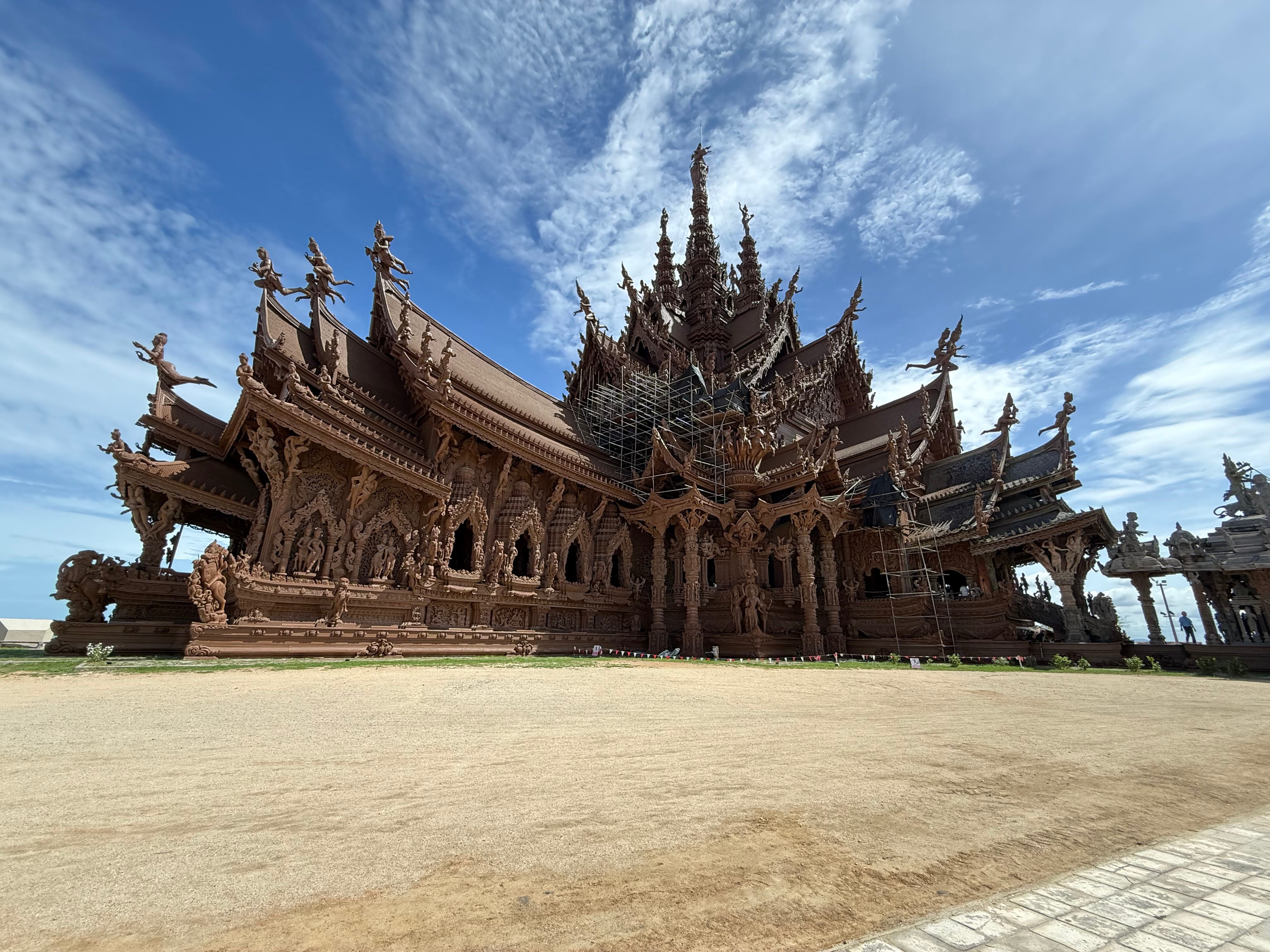
Last weekend I visited two places on the same day, not far from each other on Thailand’s eastern coast. Both were remarkable. Only one moved me.
The first was the Sanctuary of Truth in Pattaya, the largest wooden building in the world, still being completed after more than four decades of construction. Its stated purpose is profound: to help visitors understand the nature of existence and find a path from suffering towards enlightenment. The scale is genuinely breathtaking. Every surface is carved by hand, layer upon layer of figures and mythology rising some hundred metres into the sky. As a feat of human vision and craft, it is almost without parallel.
I wanted the experience to match.
It didn’t. To manage the volume of visitors, you join a tour group. A guide leads you from point to point, narrating continuously — the symbolism of each carving, the religious traditions represented, the construction timeline. The information is thorough. The care is evident. But there is no space in it. You move when you are told to move, look where you are directed to look, and the continuous narration fills every gap where something quieter might have arrived. The place was built for contemplation. The experience it has constructed makes contemplation almost impossible.
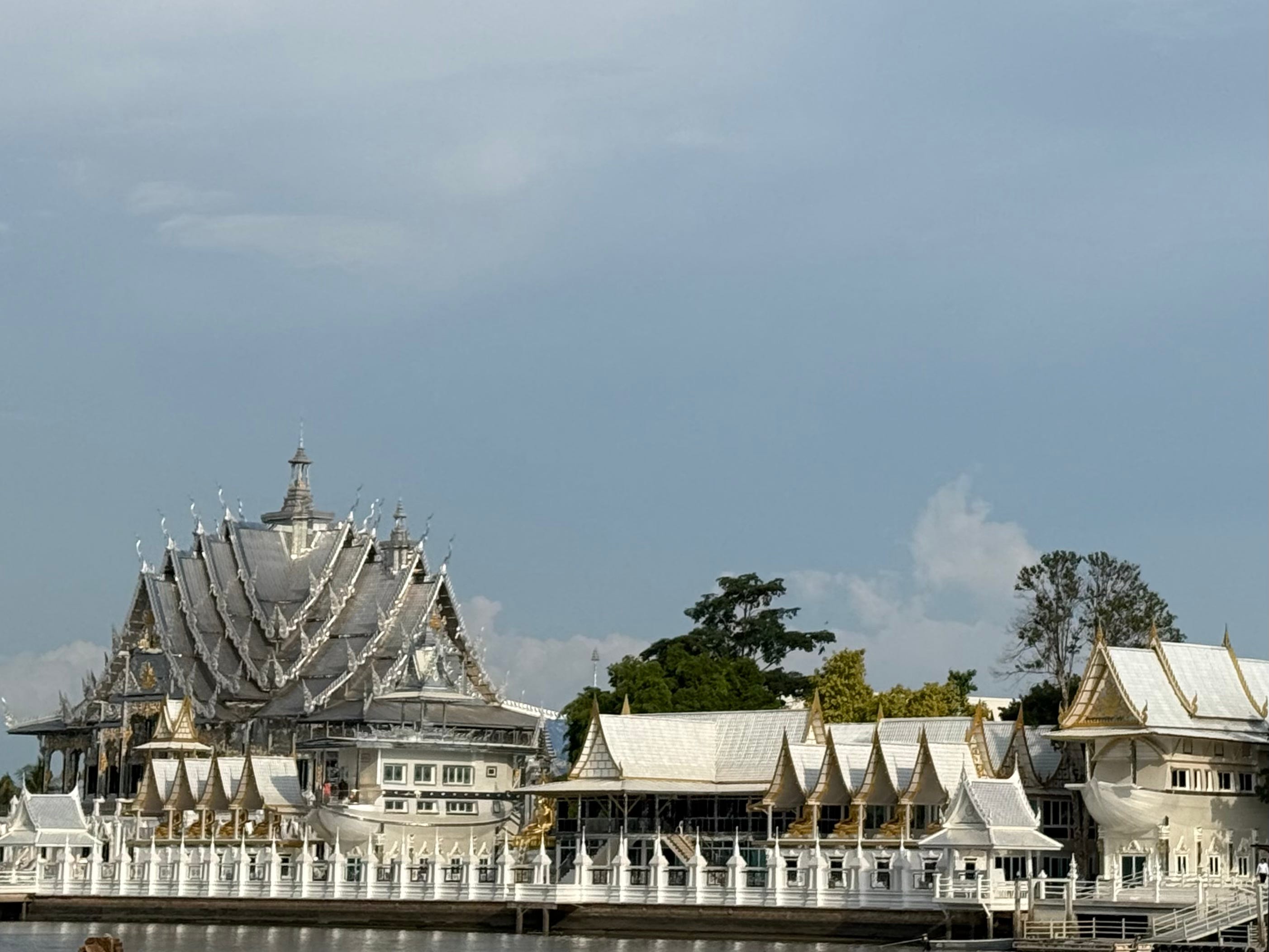
The second stop required a little more effort to reach. Wat Phuttha Prommayan sits in Chachoengsao, a province east of Bangkok that most visitors pass through rather than pause in. We had seen a photograph of it some months earlier and quietly filed it away. A short ferry crossing takes you from the riverbank to an island in the middle of the Bang Pakong River, where a temple complex of silver and white rises without announcement from the water.
It is not on the standard itineraries. It does not shout about itself.
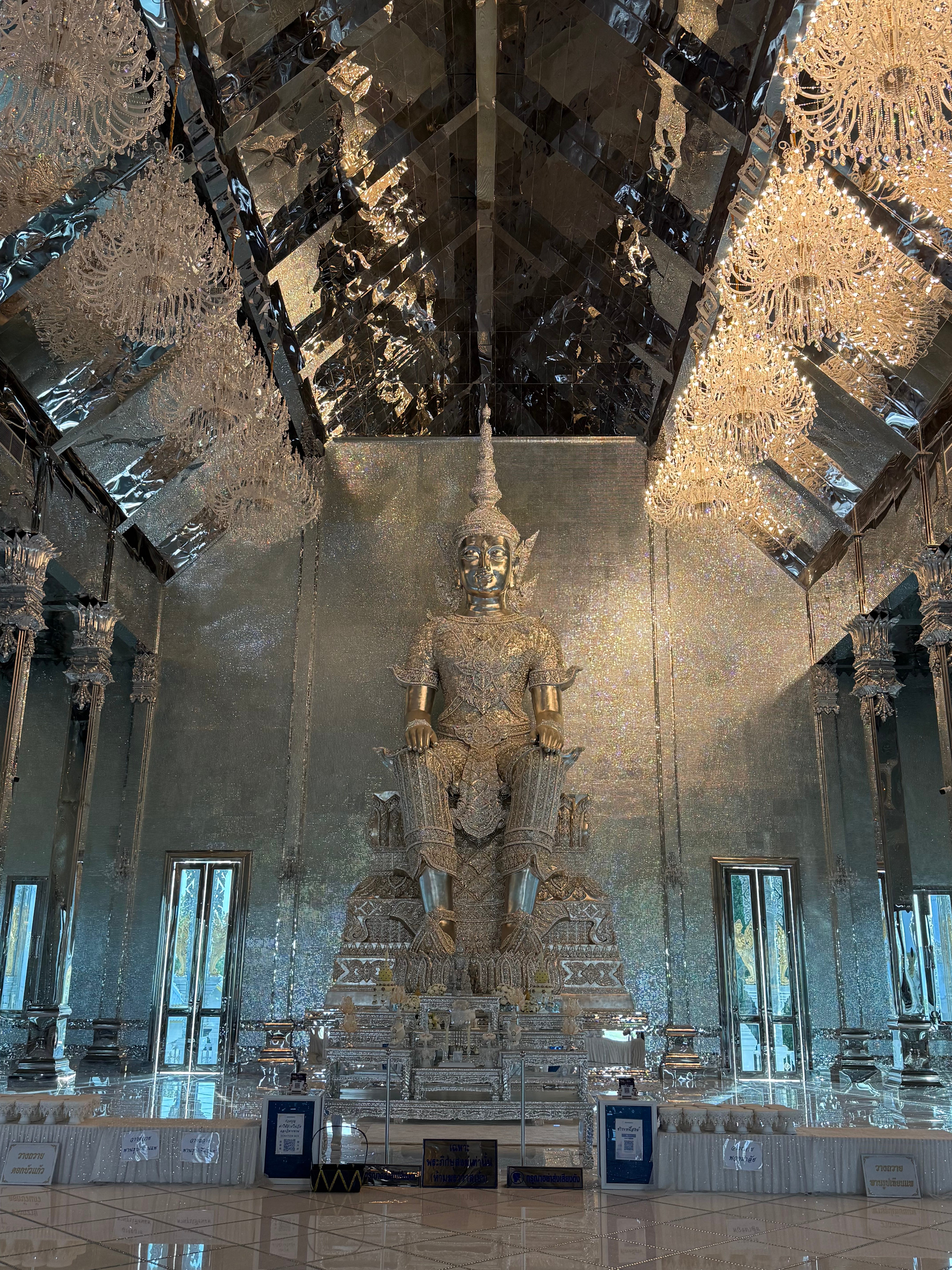
Inside the main hall, the walls and ceiling are entirely mirrored, refracting light in every direction. A seated Buddha in silver occupies the far end, flanked by chandeliers. The effect is extraordinary, not in a way that demands your reaction, but in a way that simply is, and lets you find your own way into it. Outside, a breeze came off the river. Other visitors were there, but quietly, in their own relationship with the place. Nobody was directing the experience.
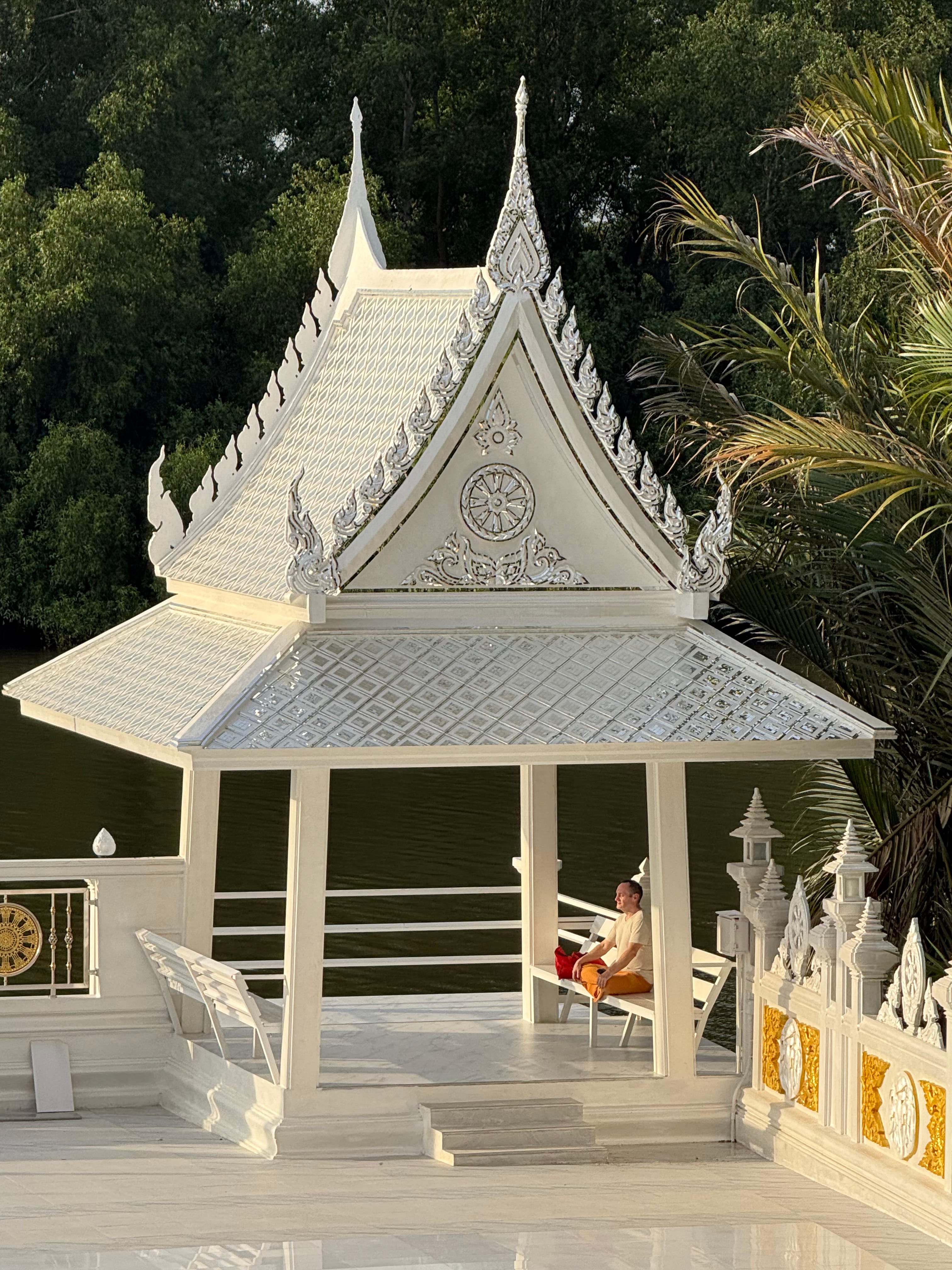
I sat for a while in one of the open pavilions looking out over the water. I didn’t need to be told to sit there. I didn’t need to be told what it all meant. Something settled in the stillness, and that settling was the experience.
The contrast stayed with me on the drive back to Bangkok.
The Sanctuary of Truth has a beautiful and sincere vision. The people who built it, and who continue building it, clearly believe in what they are creating. But somewhere between that vision and its delivery, something went wrong. In trying to ensure that every visitor understands what they are seeing, the experience of simply being there has been engineered out of existence. The apparatus built to serve the purpose has quietly become its obstacle.
This is not a rare failure. It happens in organisations all the time.
Leaders articulate values around trust, or openness, or psychological safety, or creativity. They mean it. Then they build the systems and processes intended to embed those values, the programmes, the frameworks, the reporting mechanisms, the structured conversations, and somewhere in that build, the original thing gets crowded out. The values become something to be communicated and measured rather than something to be experienced. The organisation ends up working very hard to deliver something that requires, above all else, space and quiet to arrive on its own terms.
The teams that carry genuine psychological safety rarely have a psychological safety programme. The cultures where people speak honestly rarely have a speak-up framework. They have leaders who have understood that some things cannot be manufactured, only permitted, who have learned to give space rather than fill it, and who trust that the experience will come if the conditions are right, and resist the instinct to narrate it into existence.
The question worth sitting with is a precise one: does your operational model actually support your stated vision and values, or has it gradually become the thing that makes them impossible to experience? It is rarely a dramatic failure. It accumulates quietly, one reasonable process at a time, until the original intention is buried under its own infrastructure.
The silver temple did not try to teach me anything about enlightenment. It simply existed, in its lovely setting, on its island in the river, and let the rest happen.
One of the things executive coaching can surface is exactly this gap: between what a leader intends and what their organisation actually experiences. It is rarely a question of bad intent. It is usually a question of accumulated structure that has grown up around a vision and gradually begun to obscure it. If you are noticing that tension, I would be glad to hear from you.